Emergent Narratives Transition

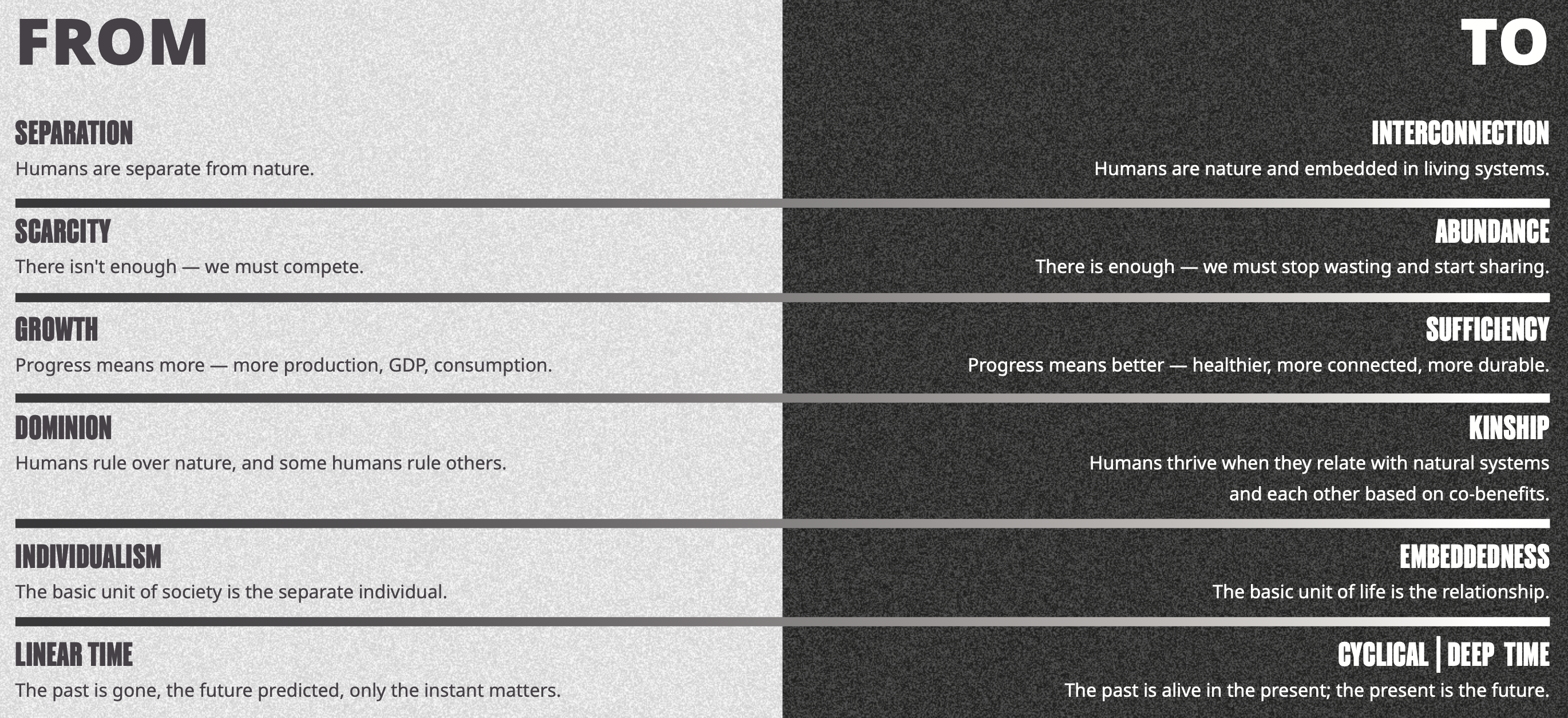
Ashoka Fellow David Bornstein's Solutions Insight Lab analyzed 10,000 'solutions journalism' news stories from 182 countries and identified six narrative transitions.

"Another world is not only possible, she is on her way.
On a quiet day, I can hear her breathing."

– Arundhati Roy

emerging paradigm climate narratives

How can we be disciplined in our narrative work to support these transitions?

Over 3 days, social entrepreneurs, policymakers, researchers, journalists, youth leaders, and movement builders debated this question.

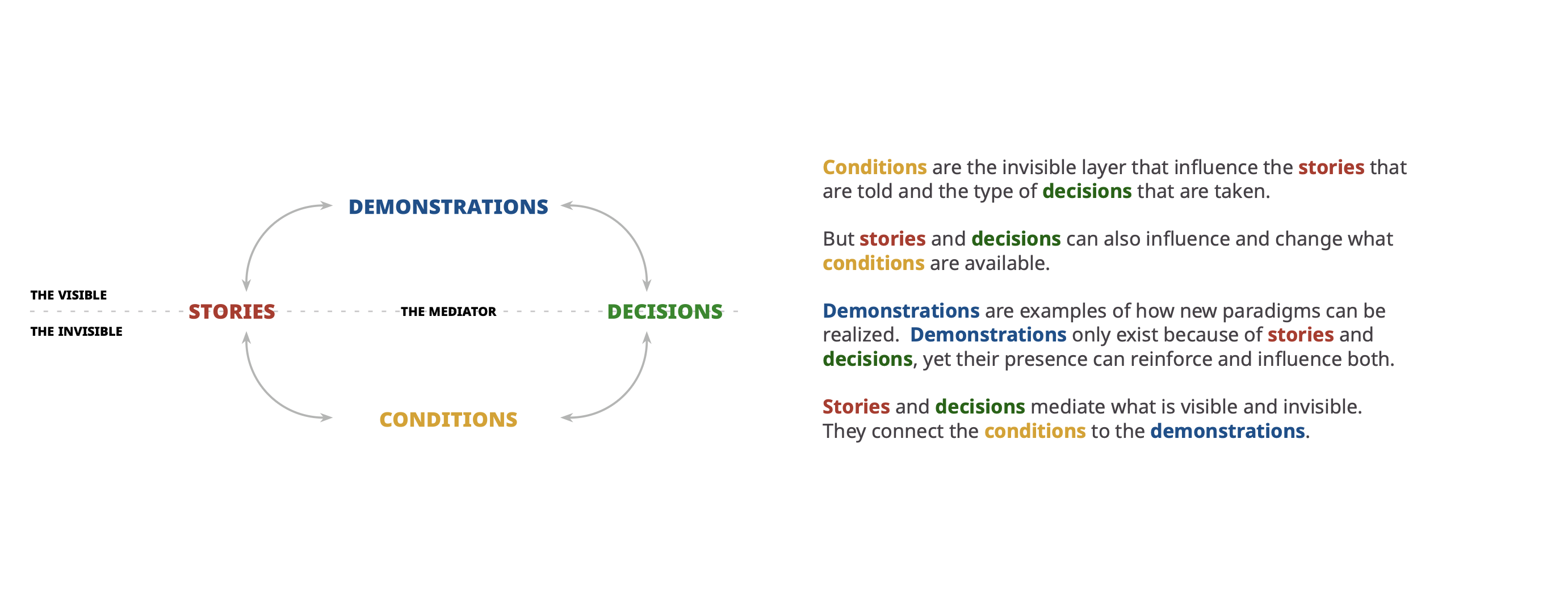
The result? To support the emerging paradigm we need to:

  1. strengthen stories of possibility;
  2. create conditions for possibilities to become real;
  3. shift decisions to
  4. demonstrate that the emerging paradigm is already happening.
CNJ

THE CYCLE

chapters_full
The Cycle


Practical Invitations

These four dimensions of narrative work
opened up practical ways to expand what's politically, culturally, and socially possible in climate action. 

Read below the invitations that emerged from the thought leaders.

1. STORIES – How meaning shapes action

People don't just change because they receive new information.

They change because they begin to understand themselves, their communities, and their relationship to the 
world differently.

2. CONDITIONS – Transform alternative stories into commonsense

People rarely change because of better arguments. 

They change because the architecture around them changes. And what's at their disposal becomes what's possible and normal.

Different people move for different reasons. Stop searching for THE perfect narrative. Focus on conditions that shape the systems that allow MANY narratives to succeed and resonate simultaneously.

3. DECISIONS – Change the rules

We tend to focus too much on changing people's minds, when what we really want is to change behavior.

The challenge is not simply persuading people that a different future is desirable. It is redesigning the conditions that shape the thousands of conscious and unconscious decisions people make every day. 

When the sustainable choice becomes the easier, cheaper, safer, and more rewarding choice, behavior changes at scale.

4. DEMONSTRATIONS – Why can't we have that here?

People rarely support futures they cannot imagine.

Organizations rarely support transitions without a business case. 

The role of demonstrations, pilots, prototypes, and role models is not simply to prove that something works. 
It is to prove that something is possible.

Climate action succeeds when people experience it.

Not as sacrifice for the planet, but as participation in a better future. 

Stories expand possibility. 
Conditions make possibility durable. 
Decisions turn possibility into reality. 
Demonstrations allow possibility to spread.

The task ahead is not simply to tell better climate stories.
It is to build societies in which multiple forms of living – and your stories – can thrive.

MEET THOUGHT LEADERS

JUNCTION PARTICIPANTS:

INTERVIEWEES: