KEY LEARNINGS

In a Junction, an intimate and responsive space for proximate leaders to forge creative directions in their fields, Ashoka Fellows and Young Changemakers shared their insights about Lifelong Environmental Agency. Learn more about the group's key takeaways:

I. Environmental agency is relational

Agency does not reside in individuals alone. It emerges through relationships between people and ecosystems, across generations, and within the institutions that structure everyday life.

Designing for environmental participation means designing for connection: between people, between life stages, between local action and broader systems. 

II. Environmental justice is the starting point

Environmental agency is not equally available. Access to safe environments, green spaces, political voice, institutional support, and time varies profoundly across race, gender, territory, and economic conditions. 

Designing for lifelong environmental agency means first acknowledging these inequalities and actively working to remove the structural barriers that prevent participation. 

III. Different bodies experience climate change and climate action differently

Health status, physical capacity, age, and embodied relationships with the living world shape what environmental participation looks like and who can sustain it.

Effective initiatives recognize the diversity of human bodies and the different ways people encounter, sense, and respond to ecological change. 

IV. Agency develops across the life course, and every stage matters

Childhood, adulthood, and later life each present distinct opportunities and constraints.

Early encounters with nature can cultivate lasting ecological belonging. Adulthood brings structural pressures that must be addressed, not assumed away. Later life holds place-based knowledge and intergenerational care that environmental systems rarely mobilize. Knowing the possibilities and challenges of each stage is essential to designing for a lifelong contribution. 

V. Enabling conditions determine whether participation is possible

Policies, institutions, infrastructure, and collective spaces shape who can act and how. 

A focus on individual awareness or behaviour alone is not enough. Strengthening environmental agency requires building the systems across education, health, urban planning, and community life that make participation meaningful and sustained. 

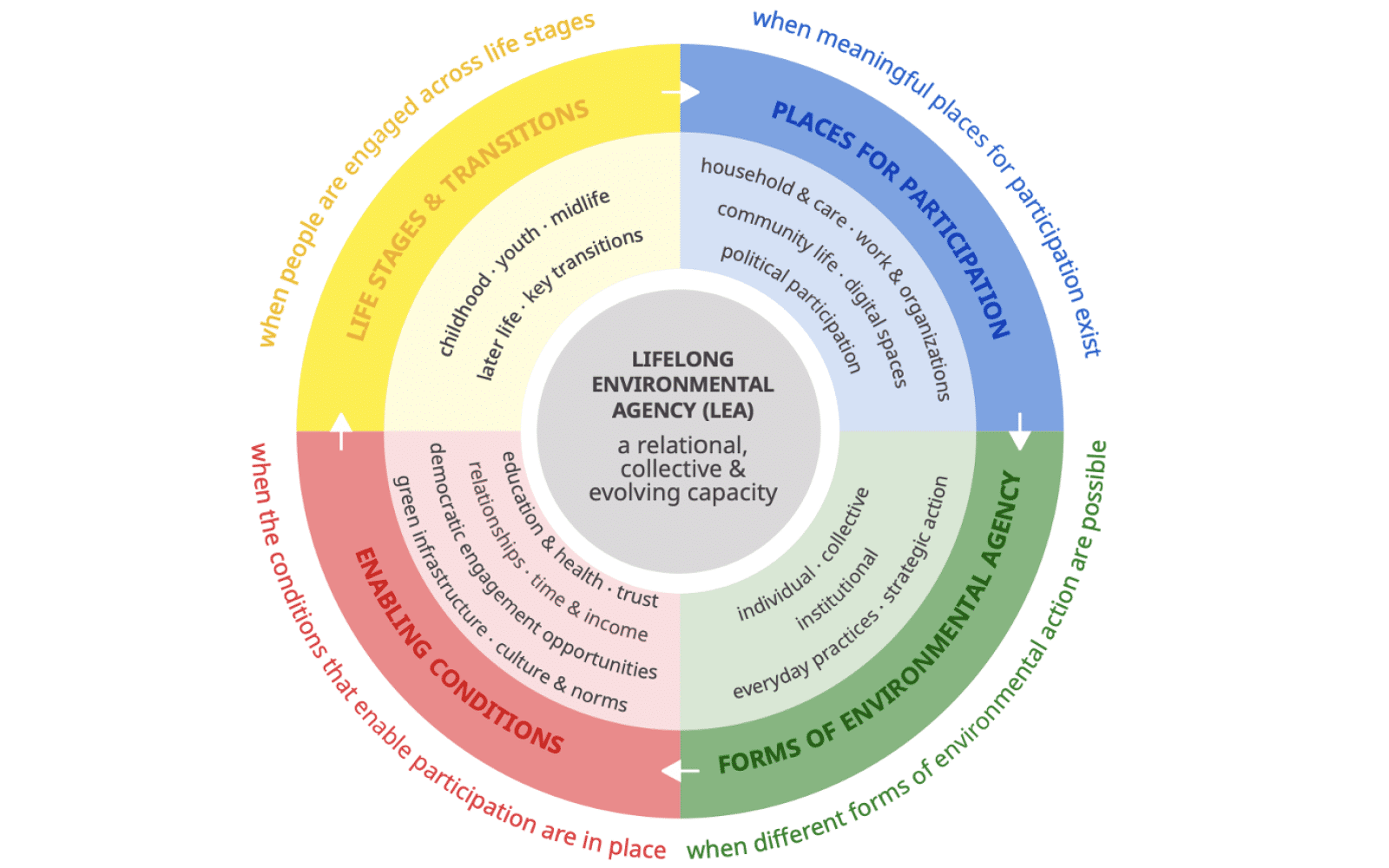
The Four Dimensions of the Framework:

LIFE STAGES

Environmental agency unfolds across time. Childhood, youth, adulthood, and later life each present distinct opportunities and constraints shaped by social roles, institutional expectations, health, and access to supportive environments.

 DescriptionOpportunitiesConstraintsNature
Access
Mediation
Powerful
Transitions
ChildhoodEarly experiences can cultivate curiosity, care, and relational sensibilities toward the living world. Yet the same systems can weaken these dispositions by limiting contact with ecological processes. 
  • Nurturing curiosity 
  • Developing empathy for nature
  • Hands-on learning (gardening, clean-ups)
  • Dependence on adults
  • Limited understanding of systemic issues
  • School, 
  • Household,
  • Extracurricular activities
  • Urban infrastructure
First moments transitioning from private family life to a social life in schools, parks, etc.
YouthFrequently, young people have a heightened engagement in civic life, including environmental activism, education, and collective initiatives. At the same time, access to quality education, safe environments, and pathways into meaningful participation varies widely.
  • Activism
  • Career choices in sustainabilityInnovative solutions
  • Conscious consumerism
  • Financial pressure
  • Career establishment
  • Feeling powerless and/or eco-anxiety
  • Peer pressure
  • Social media influence
  • School/university
  • Household
  • Urban infrastructure or lack thereof
  • Getting out of learning environments to join the
    work force
  • First experiences with decision making
    and leading projects
AdulthoodEnvironmental concern frequently coexists with structural constraints. Economic pressure, fragmented routines, and institutional silos reduce opportunities for sustained ecological engagement. 
  • Community leadership
  • Policy influence
  • Financial resources for investment
  • Mentoring younger generations
  • Family responsibilities, established routines,
    potential resistance to change, cost of
    living pressures, lack of time and/or
    financial resources.
  • Work place
  • Household
  • Urban infrastructure
    or lack thereof
  • Social structures: hospitals,
    shops, supermarkets, etc.
  • Taking on decision-making roles in the work
    place
  • Responsibility in caring roles
Later LifeOlder adults often hold long-term memory, place-based knowledge, and caregiving capacities that are essential for sustaining relational worlds. However, dominant narratives of ageing frequently frame later life as dependency rather than contribution. 
  • Wisdom sharing
  • Experienced
    advocacy
  • Legacy building
  • Volunteerism
  • Time for
    engagement
  • Physical limitations
  • Adapting
    to new technologies
  • Potential
    generational disconnect
  • Urban infrastructure or lack thereof, social structures: hospitals, shops.

Retirement


Guiding Questions

  • Who is involved across the life course?
  • Which generations are currently engaged, and which are missing?
  • Are we tapping and strengthening their potential or creating and strengthening their barriers?

PLACES FOR PARTICIPATION

Environmental participation takes place in the environments where people live, work, learn, and make decisions. These are powerful entry points for nature connection:

  • households
  • schools
  • workplaces
  •  community organizations
  • care-giving institutions (hospitals, nurseries, elderly homes, etc.)
  • faith institutions
  • digital environments
  • civic or political spaces

Initiatives can expand participation by creating or transforming these spaces so that environmental action becomes part of everyday life and institutional practice.


Guiding Questions

  • In this project/initiative/policy, where does environmental participation take place?
  • Are schools, households, workplaces, or community spaces creating opportunities to access and engage with nature?
  • Is this changing structural or experiential conditions?

FORMS OF ENVIRONMENTAL AGENCY

People engage with environmental challenges in different ways:

  • Everyday ecological practices: Food choices, energy use, or care for local ecosystems.
  • Collective action within communities: Stewardship initiatives or cooperative governance.
  • Institutional or policy influence: Advocacy and leadership training.

Clarifying which forms of agency are being strengthened helps guide the design and ambition of initiatives.


Guiding Questions

  • What kinds of environmental action are being supported?
  • Does the initiative strengthen everyday practices, collective action, or institutional change?
  • Is there any incentive for individual action?

ENABLING CONDITIONS

 DescriptionExamples
Structural ConditionsShape whether participation is even conceivable. They are the foundation on which agency is built.  
Without these, the capacity to engage with the living world remains out of reach for many, regardless of motivation or awareness.
Secure housing, stable income, access to healthcare, green infrastructure, and reliable public services.
Relational ConditionsParticipation is also shaped by the quality of our relationships and inner lives. 
They are the social infrastructure through which environmental agencies become real and sustained.
Trust in institutions, in neighbors, in the possibility of change; sense of belonging, community connection, and the feeling that one's voice and presence matter. 


Supporting Frameworks

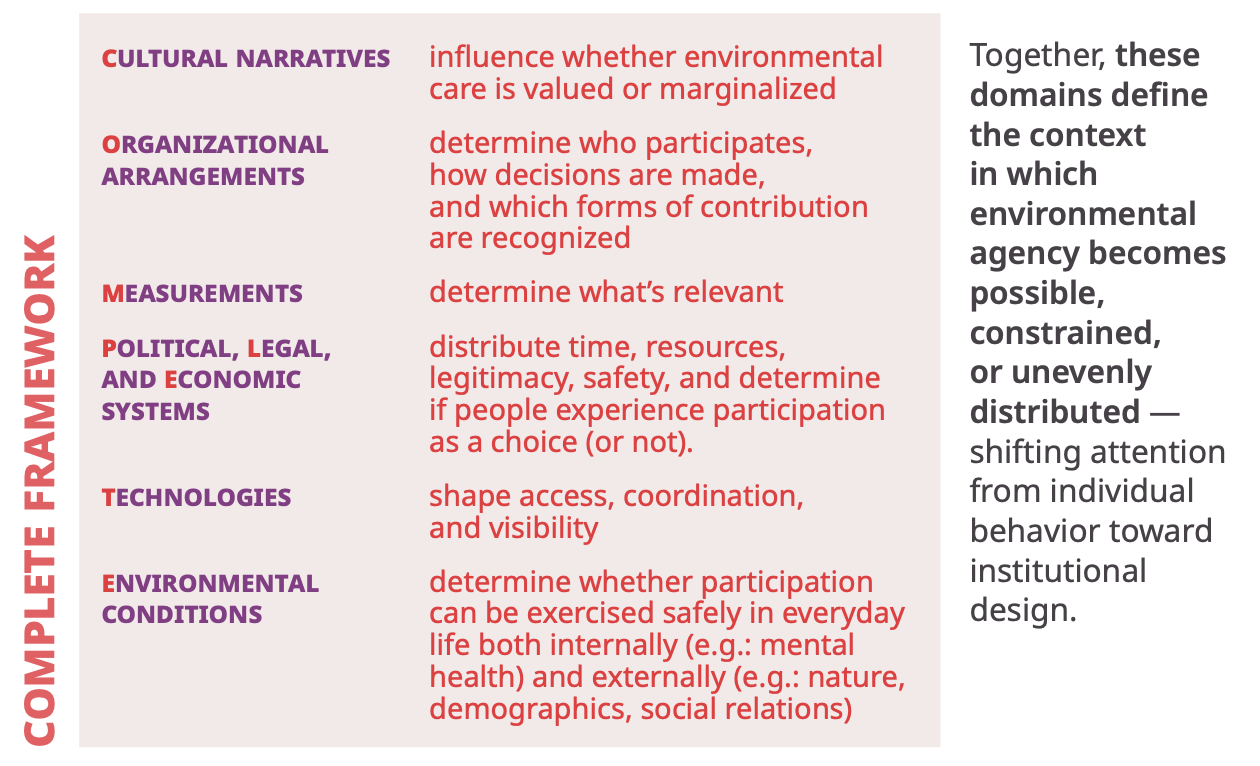
The Architecture of Decision Making: mapping the conditions for possible decisions 


COMPLETE Framework


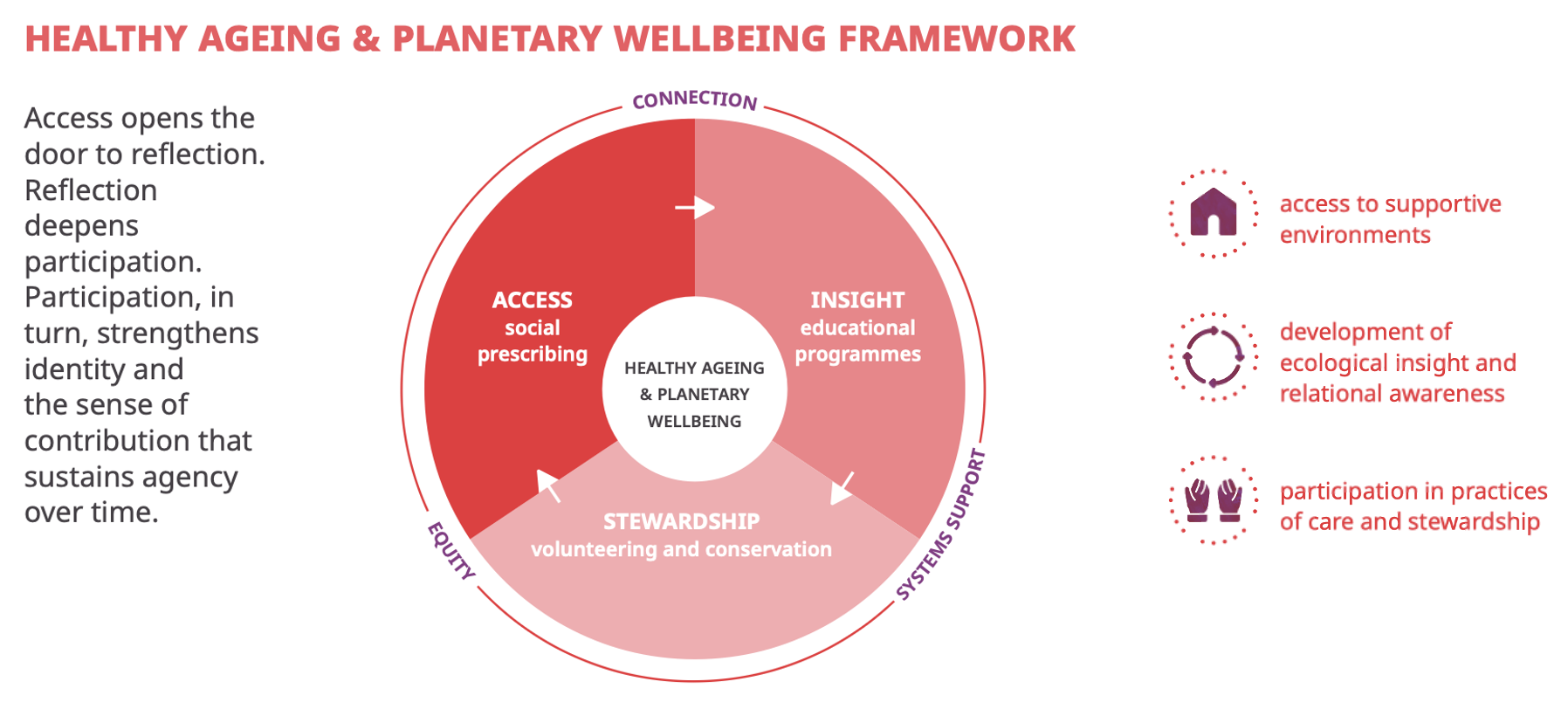
The Experiential Activation: healthy ageing & planetary wellbeing framework


Healthy Ageing and Planetary Wellbeign


Guiding Questions

  • What are the conditions in place to make participation possible?
  • Are there barriers related to time, resources, knowledge, access to green spaces, or institutional support that we need to overcome here?
  • What structural and experiential changes would unlock broader participation?

DESIGNING PRINCIPLES FOR LIFELONG ENVIRONMENTAL AGENCY

The task is to build a shared field of practice, where lifelong environmental agency evolves from an aspiration into something deliberately designed, resourced, and implemented.

Start with justice, not individual behavior.

Environmental agency is unevenly distributed, shaped by race, territory, gender, age, and economic conditions that determine who can participate, in what form, and whose contributions are recognized. Different bodies encounter both ecological risk and environmental action in fundamentally different ways. Any agenda for lifelong environmental agency must begin by confronting these inequalities, not assuming them away. Initiatives that ignore structural barriers will reach only those already able to participate. 

Design for the full life course and the transitions within it.

No single stage of life is sufficient. Early encounters with nature cultivate ecological belonging that can last a lifetime but only if adulthood does not sever that connection through structural isolation. Older adults carry place-based knowledge and intergenerational memory that most systems fail to mobilize. The most durable environmental initiatives, as seen across Ashoka's network, are those that connect generations rather than serving one cohort in isolation. The transitions between stages (entering the workforce, becoming a caregiver, retiring) are moments of particular leverage. 

Align structural conditions with lived experience.

Institutions and policies set the conditions for participation but conditions alone do not produce agency. What the evidence from Ashoka Fellows shows is that participation becomes meaningful and sustained when structural support meets lived experience: access to nature and community, opportunities to reflect and connect, practices of care that feel relevant and real. Reform without activation remains abstract. Engagement without structural backing remains fragile. The field must build both, together. 

Different people have different roles.

 
How to translate these insights into action?
Policymakers
  • Integrate environmental participation into the systems people already move through education, health, urban planning, and care.
  • Prioritize intergenerational design and remove barriers that exclude specific bodies, territories, and life stages.
FundersInvest in the infrastructures of continuity: community spaces, long-term partnerships, and learning networks that help initiatives adapt across changing conditions.
Practitioners
and designers

Make your design choices explicit. 

  • Which life stages are you reaching?
  • Which bodies are you designing for?
  • Which conditions are you building and which are you assuming already exist?

The framework offered here is a tool for that reflection.

MEET THE JUNCTION PARTICIPANTS